

Kathmandu – In a historic victory for Nepal’s sexual and gender minorities, the country’s new Constitution explicitly protects them against discrimination. The progressive inclusion of these protections was secured thanks in large part to the coordinated advocacy efforts of civil society groups such as Blue Diamond Society, whose work is supported by the Multi-Country South Asia Global Fund HIV Programme and the UN Development Programme (UNDP).
“The sexual and gender minority groups of Nepal have been granted full and equal constitutional rights. No longer can we be excluded from social services such as housing, education, employment and health care,” proclaimed Manisha Dhakal, Executive Director of Blue Diamond Society (BDS). “We will continue to advocate policy makers to ensure that the provisions are properly implemented, and that further laws and policies that address the needs of our community are formulated.”
After more than seven years of struggles and anticipation, the new Constitution was formally endorsed in Nepal’s Parliament on 16 September and promulgated on 20 September 2015.
Article 18 of the Constitution, on Right to Equality, specifically states that marginalized groups, which includes sexual and gender minorities, will not face discrimination by the state and judiciary. Furthermore, the Constitution contains articles which specify that citizens of Nepal are permitted to decide what preferred gender identity appears on their citizenship document, and that gender and sexual minority groups have the right to full participation in state mechanisms and public service “on the basis of the principle of inclusion”.
Across South Asia, lesbian, gay, bisexual and transgender (LGBT) people continue to face discrimination in society, including harassment, abuse and restrictions on access to social services. These violations can create barriers to accessing vital health services and increase risks and vulnerabilities to HIV.
“Civil society has a critically important role to play in contributing to creating enabling legal and policy environments – this applies for the HIV response as well as more broadly for achieving equal human development,” said Renaud Meyer, UNDP Country Director for Nepal. “UNDP believes in strong, resilient societies that are inclusive, diverse and respect the rights of all citizens.”
He added, “While there are still limitations acknowledged in the Constitution in regards to women, the presence of provisions that are inclusive of sexual and gender minorities demonstrates major progress in the protection of vulnerable groups in Nepal.”
Over the past several months, Blue Diamond Society, under the Multi-Country South Asia Global Fund HIV Programme, organized a series of sensitization and advocacy efforts with key individuals involved in the Constitution drafting process, providing information on specific technical language and data on sexual and gender minority human rights:
- In July 2015, five regional workshops were organized – one in each development district of Nepal – to engage the community in the Constitution drafting process. The workshops were attended by more than 100 representatives of the sexual and gender minority community and produced a set of community recommendations. Over 100 Constituent Assembly members from across the country were then reached out to with these recommendations through a coordinated advocacy effort.
- In February 2015, a South Asia regional consultation on transgender and hijra rights and health provided an important forum for the transgender and hijra community to articulate their struggles and to engage in constructive discussion with law and policy makers. It was inaugurated by the Minister of Information and Communication and included two members of the Constituent Assembly as panelists.
- In August 2014, a national consultation examined barriers and challenges faced by community groups in achieving equal access to health services, employment and education. More than 200 participants from across the country attended, including representatives from the Ministry of Women, Children and Social Welfare, the National Human Rights Commission, Home Ministry, the Ministry of Health, members of the Constituent Assembly, civil society as well as local government authorities.
- In February 2014, a workshop on the inclusion of sexual and gender minority rights in the Constitution was held with officials from the National Human Rights Commission, including representatives from the different regional and sub-regional offices.
The efforts were reinforced by evidence from a 2014 study by BDS, UNDP and The Williams Institute which found that discrimination was widespread in Nepal and that existing anti-discrimination provisions were failing to sufficiently protect sexual and gender minorities.
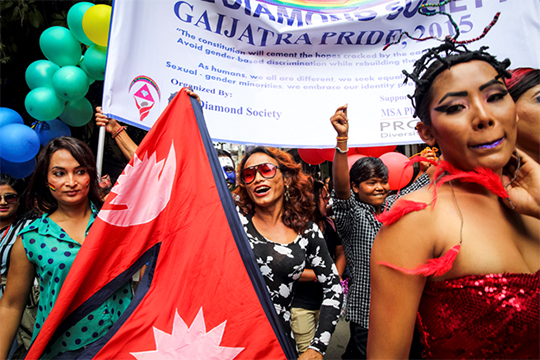
Keeping the issues in the public eye has been central to BDS’ advocacy efforts. For the past several years they have organized large annual ‘Pride’ festivals to openly express their demand for the rights of sexual and gender minorities to be guaranteed in the Constitution. They will continue to advocate for the rights of sexual and gender minorities through mediums such as TV, radio shows, engagement with the media and social media.
It is hoped that the successful advocacy and coalition building efforts can serve as an inspiration for other initiatives seeking to achieve progressive legal and policy change.